



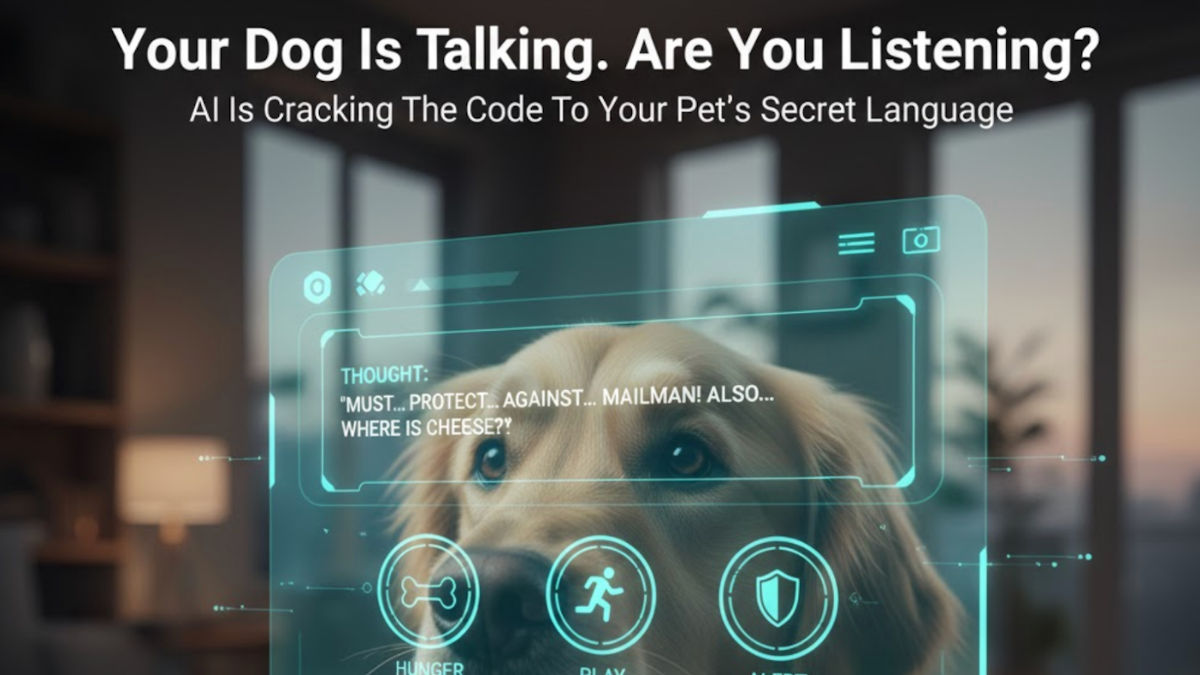
Hold on. We’re about to crack one of humanity’s oldest mysteries. What is your pet really trying to tell you?
Is that bark excitement, anxiety or a dramatic demand for cheese? Is your cat affectionate or quietly plotting your demise? I’d love to be able to have a conversation with my golden retrievers, or at least better understand what they want.
They know certain phrases for sure, from “Let’s go potty” to “Do not go in the pool.” But how cool would it be when I walk in the door, if Bella would say, “Hey, Mom, sorry. I didn’t mean to chew up your Peloton bike shoes.” Yea, that happened yesterday.
🐶 Dr. Dolittle
There aren’t a lot of products that really do interspecies communication (that’s what it’s called, btw).
MeowTalk analyzes your cat’s meows against 40 million recordings. That sounds great, but it has a really bad 1.5-star rating on Google Play. Folks report connection errors, translations that don’t match obvious context, and one reviewer’s cat apparently only says, “Hello,” no matter if he’s hungry, sleepy or happy. Consider it entertainment. Free with $6/month premium.
FluentPet takes a different approach, teaching pets to communicate using recordable buttons. They say over 70% of dogs learn two buttons within a month. My golden retriever Abby could not grasp it. I’m ready to try again with Bella.
In case you want to see it in action, Bunny the Sheepadoodle on TikTok, with 8 million followers, is an apparent Mensa canine member.
😺 CES 2026 game changers
The big leap is about to come from applying the same AI world models used to teach machines how humans move and behave. (ICYMI, I told you about that a few days ago.) AI is being trained on massive libraries of animal video and audio, mapping ear position, tail movement, posture and vocal patterns to predict actual outcomes.
Companies like SatellAI unveiled AI collars that create a digital twin of your pet, combining behavior, biometrics and environment to spot stress or illness early.
Others went further. Ecovacs introduced LilMilo, an AI robotic pet companion that recognizes voices, learns routines and responds emotionally. Think of it as a social robot for pets and humans.
Meanwhile, Petkit showcased AI-powered feeders and litter systems that track diet, hydration and health trends. This isn’t translation. It’s care.
🧐 Is it possible?
Right now, from what I have read, pet interspecies communication is about 60% verifiable science and 40% bull. AI is excellent at pattern recognition, but we’re still years away from philosophical debates with a pug. Still, detecting distress or pain before symptoms show is a big deal.
If AI finally translates your cat knocking a glass off the counter as, “Observe my mastery of gravity, you mere human,” that would be amazing. So yes, the animals are finally getting a voice. And I have a feeling they’ve got strong opinions about the kibble.
And just because, if all dogs go to heaven, where do cats go? Purrrgatory. Meow.
🐾 Share this with a pet parent before they waste $6/month on an app that only says, “Hello.” Hit the share icons below. People are fascinated by this.
We may earn a commission from purchases, but our recommendations are always objective.