


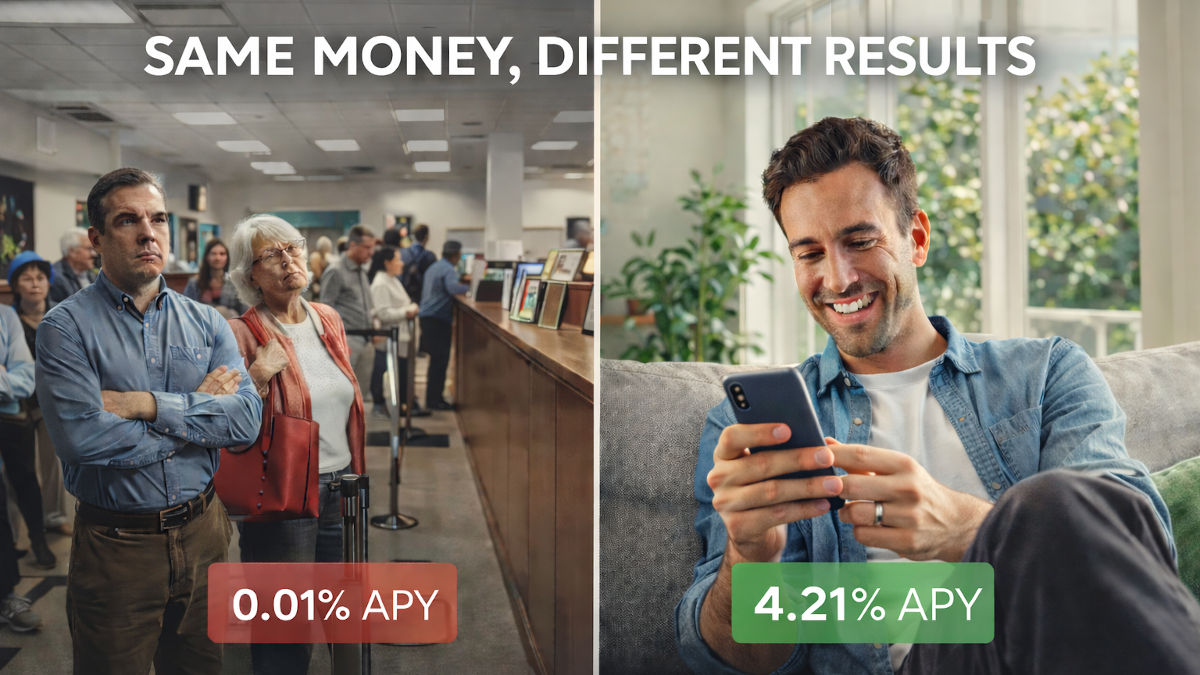
When was the last time you walked into an actual bank? Stood in line behind someone depositing 47 rolls of quarters? Yeah, me neither.
Online banking is fast, easy and available at 2 a.m. when you bolt awake remembering you forgot to pay the electric bill. But convenience always comes with trade-offs. Here’s what you need to know.
💰 The perks are real
Online banks like Ally, Marcus and Capital One offer significantly higher interest rates than the big guys. I’m talking 400 times higher because they’re not paying for marble lobbies and expensive locations.
Most have zero monthly fees and no minimum balance requirements. Some have killed overdraft charges entirely.
ATM fees? Many reimburse up to $10 or $15 a month or give you access to free networks like Allpoint with 55,000 machines nationwide. Be sure you read the fine print on that though.
✅ Is it legit?
Look for FDIC insurance. Your deposits are protected up to $250,000 per account, same as the big banks.
Not sure if an online bank is real? Use the FDIC’s BankFind tool to verify before you hand over a dime. Not in the database? Run.
Pro tip: You don’t have to go all in. Plenty of people, including me, keep a checking account at a local physical bank for cash deposits and human help, then stash savings at a high-yield online bank. Best of both worlds.
😬 The downsides
No branches means no human help when things go sideways. Account frozen? Hacked? You’re stuck on hold with a call center reading scripts while your blood pressure spikes.
Cash deposits are a headache. Most online banks don’t take them, so Grandma’s birthday money becomes a whole project involving money orders. Large checks can be a problem, too.
Some online banks cap mobile deposits at $2,000 or $5,000 per day. That insurance payout a teller would handle in 30 seconds? Could take you a week. Wire transfers can sting with fees, so check before you send.
🔐 Lock it down
Online banking is only as safe as you make it. Here’s my list for you to follow.
- Skip public Wi-Fi. Never check your balance at the coffee shop.
- Stop recycling passwords. You know better. I use the password manager NordPass.*
- Don’t use 2FA. Instead, turn on MFA by using Google Authenticator (iOS, Android) or Microsoft Authenticator (iOS, Android), not text messages. SIM swapping scams are brutal.
- Set alerts for every transaction. Especially the tiny ones. Hackers test accounts with small charges first.
- Use a separate email for banking. If your main gets compromised, your money stays put.
- Bookmark your bank’s real site. Don’t google it. Don’t click email links.
- Watch out for Zelle scams. Your bank will never call asking for a code or tell you to reverse a transaction to yourself. That’s a scammer.
Online banking isn’t going anywhere. Make sure your money doesn’t either. I have an addiction to having lots of money in my bank account. Unfortunately, I’m suffering from withdrawals.
📣 Share this: Know someone still earning 0.01% interest at a big bank? They’re literally giving money away. Share this, so they can stop leaving cash on the table and actually make their savings work for them. Use the icons below.