We killed boredom. We might regret that.
⚡ TL;DR (THE SHORT VERSION)
- Americans pick up their phones 186 times a day and spend over 7 hours on screens. We have eliminated virtually every moment of stillness from our lives.
- Creativity scores have been declining since 1990, right when screens started filling idle time.
- Boredom activates the brain’s “default mode network,” the state where original thinking, problem-solving and self-reflection happen. We didn’t just kill boredom. We killed the conditions for our best ideas.
📖 Read time: 3 minutes
 Gemini
I need your help: Add Komando.com as a preferred source on Google
Let me tell you a story. In 1990, a young woman sat on a delayed train from Manchester to London. Four hours. No smartphone. No earbuds. No Wi-Fi. She didn’t even have a pen.
So she just sat there, staring out the window.
By the time that train pulled into London, she had imagined an entire world: a boy wizard, a school called Hogwarts, seven books mapped out in her head. Her name was J.K. Rowling. That idea became Harry Potter, a franchise worth over $15 billion.
If that train ride happened today, she would have scrolled Instagram for four hours. And you and I would have never heard of Harry Potter.
That’s not a hypothetical. That’s math.
The average American picks up their phone 186 times a day. That’s once every five minutes during waking hours. We spend over seven hours daily staring at screens. And 53% of us say we want to cut back but can’t.
We have done something no other generation in human history has done. We eliminated boredom. Completely. Every idle moment, every waiting room, every quiet car ride, every line at the grocery store gets filled with a screen.
We did it so fast we never stopped to ask: What if boredom was doing something important?
🧠 Your brain on nothing
Turns out, it was.
Neuroscientists have a name for what happens when your brain isn’t focused on anything: the default mode network. It’s the state your mind enters when you’re folding laundry, staring at clouds or zoning out in the shower. And it’s where the magic happens.
In default mode, your brain connects dots it can’t connect when you’re busy. It processes emotions, replays memories, rehearses the future and wanders into ideas you’d never reach on purpose. Researchers say this is where creativity, problem-solving and self-reflection live.
But the default mode network needs one thing to activate: nothing. It needs a gap. A pause. A moment with no input.
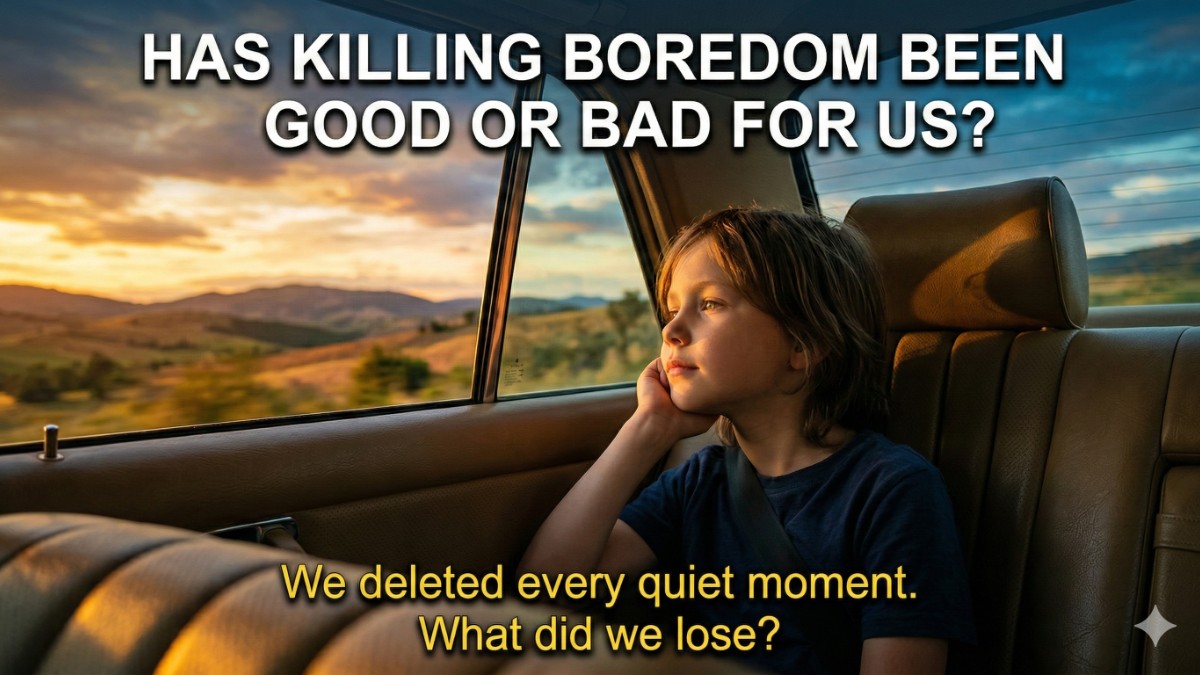
We used to get those moments constantly. Waiting for the bus. Sitting in a doctor’s office. Riding in the back seat as a kid. Now? We fill every single one of them with a podcast, a scroll, a notification, a game.
Data shows what that’s costing us. A landmark study out of the College of William & Mary analyzed nearly 300,000 creativity test scores spanning decades. Creativity had been rising steadily for years, right alongside IQ. Then, around 1990, it started falling. And it hasn’t stopped. IQ kept climbing. Creativity didn’t.
The drop was sharpest in young children. The ones who’ve never known a world without screens in every pocket.
🗳️ What do you think?
I’m not going to tell you to throw your phone out the window. (I’d be a hypocrite. I’m on mine constantly.) But I do think we accidentally deleted an ingredient from our lives that we didn’t know we needed.
Boredom wasn’t the enemy. It was the blank canvas. And I’m curious what you think. So I’m asking:
Has killing boredom been good or bad for us? Let me know what you think.
I’ll share the results next week, and I genuinely want to know where you land. Hit the button.
Maybe the smartest thing we can do is build a little of it back in on purpose. Five minutes a day with no screen. A walk with no earbuds. A car ride with no podcast. Just you and your brain, doing what brains do when you leave them alone. You might be surprised what shows up.
🗣️ TEXT/POST THIS STAT: Americans pick up their phones 186 times a day. U.S. creativity scores have been falling since 1990. Harry Potter was invented on a 4-hour train ride with no phone and no Wi-Fi. Maybe boredom wasn’t the problem. Learn more free at GetKim.com.
📩 Send this to someone who can’t put their phone down for five minutes. (So … everyone?) Forward this. It might be the nudge they didn’t know they needed. And it might spark the best conversation you’ve had in a while.