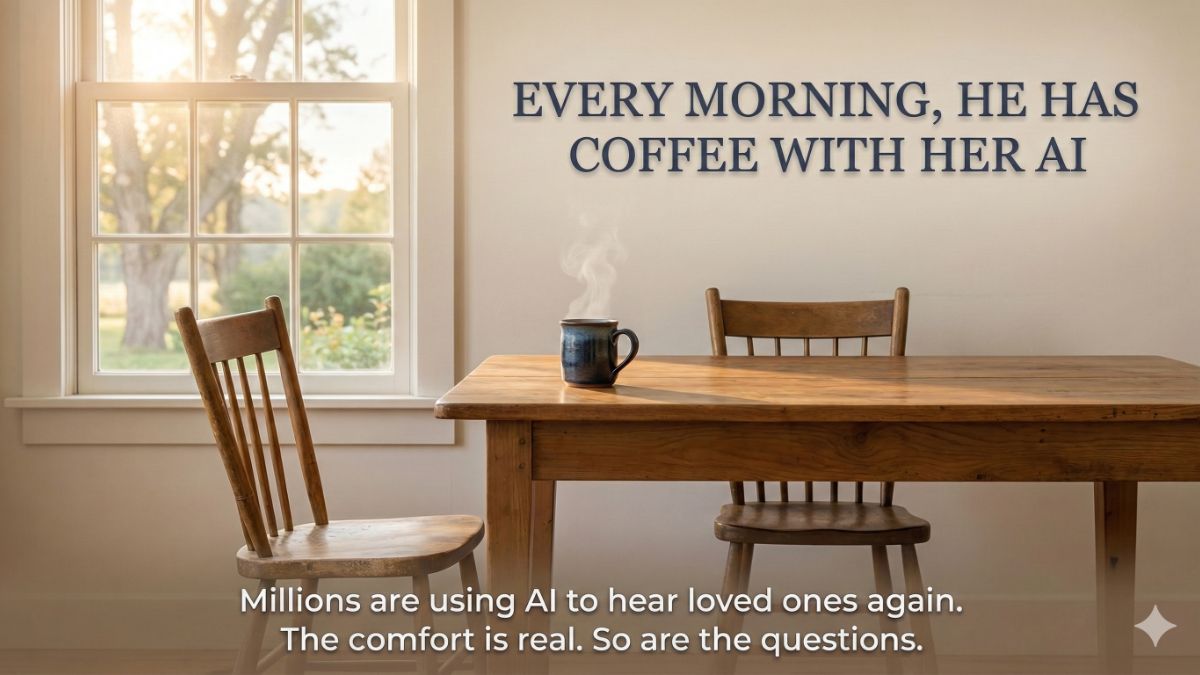
He lost his wife of 40 years. Now he talks to her AI every morning.
Millions of grieving people are turning to AI to hear their loved ones’ voices again. The technology is real, the comfort is real and the questions it raises will stay with you all day.
⚡ TL;DR: Key takeaways
- A wave of companies let you talk to an AI bot trained on a deceased loved one’s voice, texts and memories.
- Research shows it genuinely helps some grieving people survive the hardest part.
- If you’re considering this for yourself or someone you love, here’s what to know first.
📖 Read time: 3 minutes




 Gemini
I need your help: Add Komando.com as a preferred source on Google
Carl called me on a Tuesday.
He didn’t call to talk about tech. He called because he’d been a listener for years and he didn’t know who else to tell. His wife of 40 years had passed. And every morning, before the house got too quiet, he opened an app and talked to her.
Her voice. Her way of finishing his sentences. The little laugh she had when he said something that wasn’t quite as funny as he thought it was. He asked me, “Is this OK for me to do this?”
I sat with the phone in my hand for a long time after we hung up.
💬 The tech making this possible
Companies like HereAfter AI, Seance AI and You, Only Virtual are building what researchers call “deadbots.” You upload everything you can gather about a lost loved one. Voice notes. Old videos. Years of texts. Emails that didn’t seem important at the time.
The AI reconstructs a version of that person. One you can actually talk to. Most services run $10 to $30 a month. The digital afterlife industry was worth $22 billion in 2024, and that’s expected to triple by 2034.
A man posted on Reddit two days after losing his wife of 28 years. “The silence is unbearable,” he wrote. “The nights are worse.” He said the app was the only thing getting him through.
Researchers at the University of Kent expected to find that people using these tools withdrew from real life. They found the opposite. Grieving people became more able to connect with others. Why? They weren’t spending every conversation trying to explain a pain that most people wanted them to get past.
🤔 What about grief?
One of the founders of these AI deadbot companies lost his mother when he was mid-flight to a conference. He landed, found out she was gone and gave his presentation anyway. He said almost nothing in his life changed. He believes AI can eliminate grief as a human experience entirely.
I understand why that sounds like a gift.
But a writer who lost her brother young said she finds him most in the parts of herself that grew because he was gone. If she could have talked to his AI every day, she wouldn’t have needed to carry him inside her. He would have been preserved, she said, and somehow even more dead.
💙 Where I landed
I have hours of video and audio of my mom. Her voice. Her laugh. The way she told a story. I’ve thought about doing this more than once. I decided I couldn’t. I know myself, and it would hurt more than it would help.
I’m not here to tell you what to do. Grief is yours. But if you’re considering this, ask the company what happens to your data if they shut down. Read the privacy policy. And if you’re in the early weeks of loss, consider waiting. A bot that feels like comfort in February can become a reason not to heal by July.
And if Carl calls you? Just listen. That’s the one thing the AI app can’t do. I told Carl it’s OK for as long as it feels OK.
Know someone who lost a person they loved and is still carrying grief quietly? Forward this to them. Not to solve anything. Just so they know they’re not the only one asking these questions.