



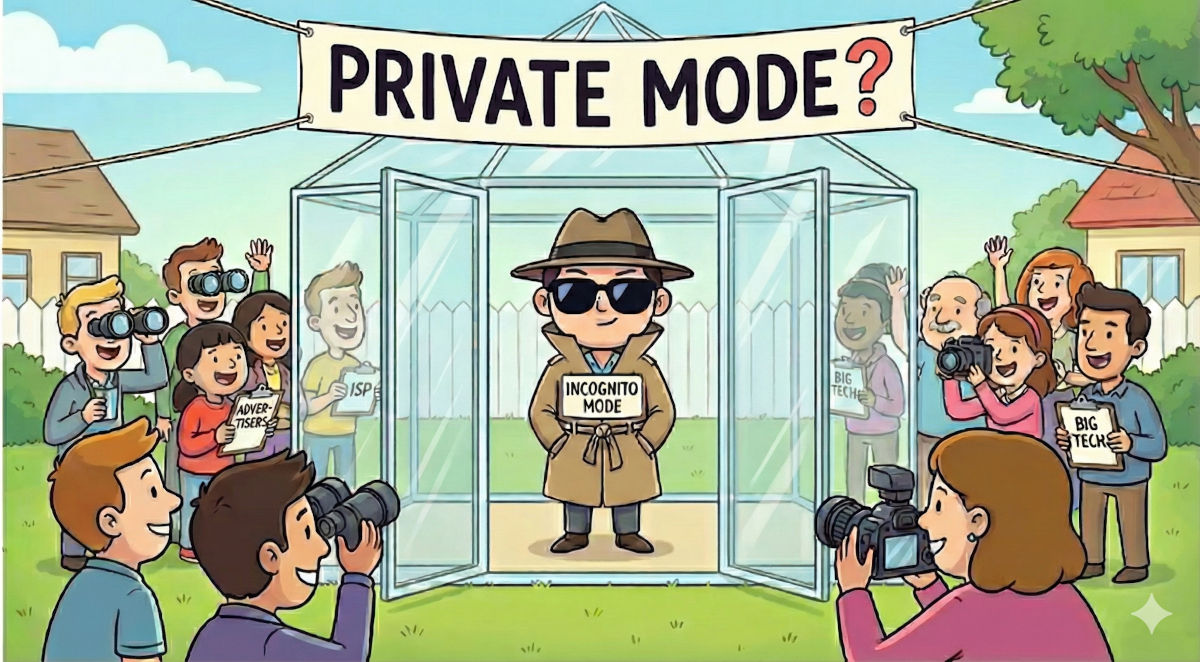

I’ve been telling you for years that your browser’s private mode is about as private as getting naked in a room with glass walls. Now we finally have proof, straight from the source. Google settled a $5 billion lawsuit accusing them of tricking millions of people into believing Incognito mode made them invisible online.
Spoiler: It didn’t. Not even close.
🕵🏼♂️ The ‘Spy Guy’ was lying to you
During the case, internal Google emails came out that were jaw-dropping. One engineer wrote that they should stop using the little “Spy Guy” icon with Chrome because it suggested a level of privacy that did not exist.
Another memo joked they should rename it “Guy Hiding in the Bushes Mode,” because even if you don’t see Google, Google definitely sees you.
🌳 What was really happening?
When you opened an Incognito tab in Chrome, you thought you were slipping off the grid for a minute. In reality, Google’s ad trackers, Analytics and other built-in tools running across the web were still logging all your activities.
Your shopping habits. Your late-night questions. Your health searches. It was all collected and tied to you.
As part of the settlement, Google has to delete billions of records of people who thought they were browsing privately. They also had to rewrite the Incognito disclaimer to admit that websites and Google itself can still track you.
Incognito mode does nothing to stop your ISP, Google, advertisers and the websites you visit from tracking your activity. You might feel hidden, but everyone sees everything.
✅ Want to actually stay private online?
Here are smart steps anyone can take:
1. Break up with Chrome. Use a privacy-first browser like Firefox or Brave that doesn’t tie your entire life to Big Tech’s data machine.
2. Install tracker-blocking extensions. uBlock Origin or Privacy Badger stop the hidden trackers most sites load in the background.
3. Turn off “ad personalization.” Google, Facebook, Amazon and Microsoft all have dashboards where you can shut down some of the snooping.
4. Use a private search engine. Startpage won’t build a profile on you.
5. And most importantly, use a VPN. This is the one step that actually blinds the snoops and trackers. A VPN hides your real IP address and encrypts your traffic so your ISP, advertisers and websites can’t follow you around.
ExpressVPN has been a longtime sponsor of my national radio show. It’s super easy to use. You literally click one button and you’re protected.
Unlike other VPNs, your connection stays fast. Plus, ExpressVPN’s tech doesn’t let even them see what you do online. Your connection is encrypted from start to finish.
If you need a VPN, you can click this link to get 4 extra months. It works on phones, tablets, PCs, Macs and TVs, too. Btw, better not jump on public Wi-Fi ever without a VPN. That’s a surefire way to get hacked and scammed. It’s the VPN I use and trust. I get no residuals or kickbacks if you sign up.
Google admitted Incognito isn’t private. Now it’s your turn to browse like you mean it.