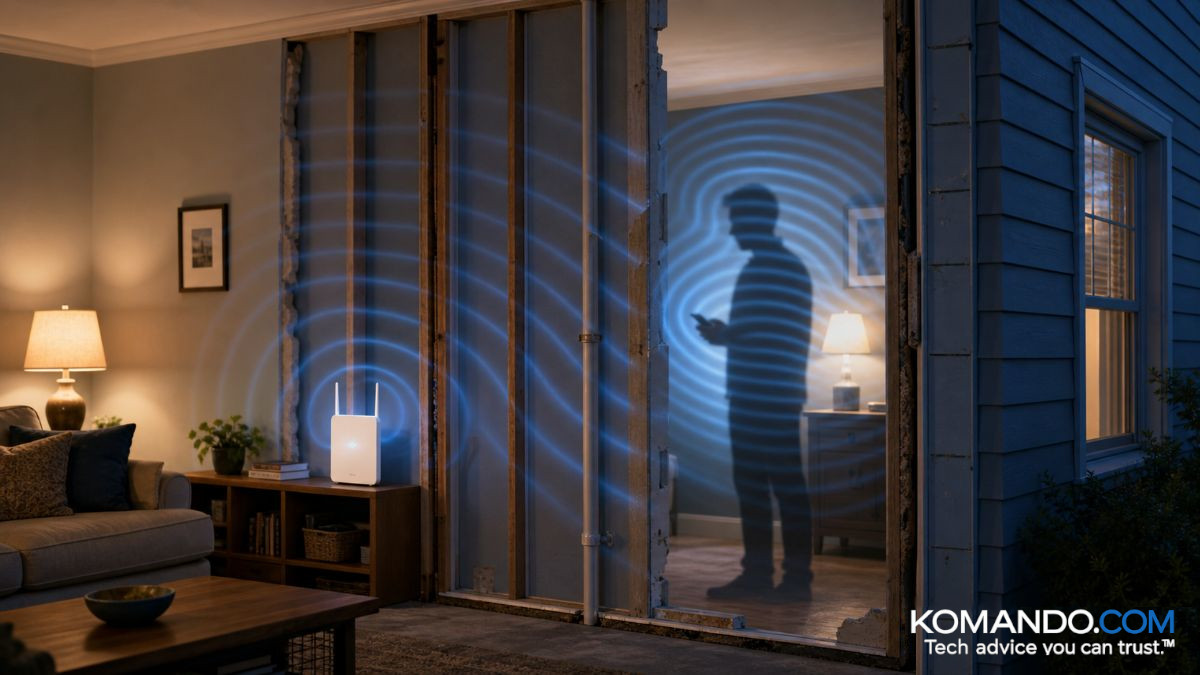
Your Wi-Fi router can “see” you move, even behind walls. No camera required.
As an Amazon Associate, some links pay us a commission at no extra cost to you. Keeps this website free. Thank you.
That box on your shelf isn’t just sending you Netflix. New Wi-Fi sensing reads how your body bends the signals bouncing around your home, accurately enough to track movement through walls. Here’s how it works, and why nobody asked your permission.
⚡ TL;DR
- Wi-Fi signals bounce off your body to detect motion, count people and track breathing, even through walls.
- This isn’t a science project. It’s an official Wi-Fi standard.
- No camera, no mic, no warning light. Most people have no way to know it’s running.
📖 Read time: 3 minutes
 ChatGPT/Kim Komando
I need your help: Add Komando.com as a preferred source on Google
Here’s something you never thought the boring little box blinking on a shelf, aka your router, could do.
It knows when you walk across a room. Which room you’re in. Whether you’re standing or lying down. All without a single camera.
📡 How a ‘dumb’ box learned to watch
Your router fills your home with invisible radio waves. Every time you move, your body blocks, bends and bounces those signals, like your hand throwing a shadow across a flashlight beam. Software reads the shadows. Walls don’t stop it. Wi-Fi sails right through drywall, so it “sees” you in the next room.
The tech doesn’t catch you only when you’re walking. Researchers have used ordinary Wi-Fi to detect the tiny rise and fall of your chest and even estimate your heart rate. Lying still under a blanket in the dark? The signal still knows you’re there, breathing.
In September 2025, the industry made Wi-Fi sensing an official standard, baking it into the chips. Most newer routers got it.
Then in February 2026, security giant ADT paid $170 million for a Wi-Fi sensing startup. Comcast and Linksys already sell motion features, and they don’t rely on the router alone.
Your stationary gadgets, like mesh nodes and smart speakers, work as extra sensing points. More devices, fewer blind spots.
One more thing: Researchers in Germany identified specific people with near-perfect accuracy by how they disturbed the signal. Not “someone’s home.” You.
👀 The part that bugs me
Cameras have a lens you can cover. Microphones have a light. Wi-Fi sensing has nothing. No glow, no shutter, no notification, no law saying anyone has to tell you it’s on.
Sold as a perk, it sounds lovely. Know if Grandma fell. But who’s home and when and where they sleep are the kind of map a burglar, a stalker or a nosy company would love.
Open your router and security apps today and hunt for anything labeled “motion” or “Wi-Fi sensing.” If you didn’t turn it on, turn it off.
If you rent a router from your internet provider, they control the firmware, not you. Buy your own. I like this $70 ASUS. You ditch the monthly rental fee, and you own the off switch.
Your router used to bring the world into your home. Don’t let it send reports of what happens inside back out. You don’t know who is buying this data.
📩 Send this to someone who swears they’re safe because they don’t have any cameras in the house.