



The great Bitcoin dumpster fire

Picture this: It’s 2013. A guy named James Howells from Newport, Wales, is cleaning up his office and accidentally throws out an old hard drive. No big deal, right?

Wrong.

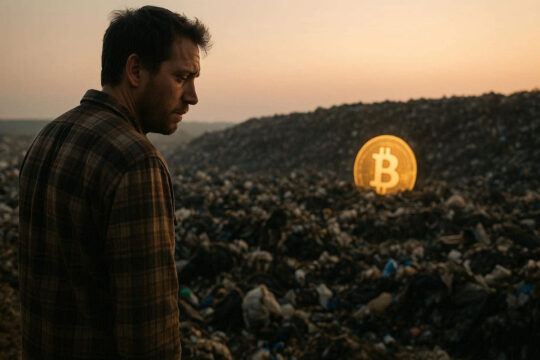
Stored on that hard drive were the digital keys to 8,000 Bitcoins. Back then, Bitcoin was worth around $130 each, a solid chunk of change. But today? One Bitcoin is worth about $122,000, which means James accidentally trashed almost $1 billion. With a “B.”

🗑️ It all went to waste

James’ Bitcoin passkey is buried somewhere under 110,000 tons of garbage in the city dump. For more than a decade, he’s begged officials to let him search. 

He offered to foot the entire bill, buy the landfill, use high-tech, robot-assisted excavation tools and split the recovered Bitcoin with the city. He even lined up investors and engineers. But the city said no. Again and again. Too messy, too expensive, too risky.

So now, he’s doing something completely wild.

🪙 Trying to create interest

James just launched a new cryptocurrency called Ceiniog Coin (that’s “penny” in Welsh). 

Here’s how it works: The 8,000 Bitcoins James lost are still technically tied to his crypto wallet. They’re frozen in time. No one can access them without the key on that hard drive. 

So James is offering Ceiniog as a kind of tribute meme coin, tied to the legend of the missing landfill billion. Buyers of the coin are essentially investing in his story.

🦄 Dump and dumpster

Continue reading

Don’t get tricked by “oops” money

Open/download audio

A “wrong number” cash drop on Zelle or Venmo is not a mistake. Criminals use stolen cards to make you the fall guy, tricking you into sending your own money. Here is how to spot it and stay safe.

The phone scam evolution: This is frightening. A cybersecurity firm built a real-time voice deepfake, meaning someone can sound like you on a call instantly. Cheap laptop, open-source tools, done. They tested it, and people fell for it almost every time. So when your “boss” calls asking for gift cards, maybe call back first. You should take a sec and check it out.

3,821%

That’s how much Pokémon cards have surged since 2004. For context, the S&P 500 managed a measly 483% in the same stretch. Translation: Pikachu just smoked your retirement account (paywall link). One near-mint Pikachu Illustrator sold for $5.3M, proving that a tiny crease can tank your portfolio faster than a bad earnings call. 

Don’t miss rewards: From groceries to travel, Clark.com has a list of the best credit cards to help you maximize every dollar you spend. Subscribe to Clark.com’s free newsletter to receive more must-have money tips every day.

♣️ Hackers, hustlers and high rollers: This is nuts. The feds unsealed an indictment straight out of Ocean’s Eleven, full of poker tables with hidden cameras, hacked Deckmate shufflers, even contact lenses that read cards. 30+ people, including the NBA’s Chauncey Billups, Damon Jones and Terry Rozier, were charged in a $7 million poker scam tied to Mafia families. Maybe your uncle blaming the game for being “rigged” was actually onto something. But also, maybe he’s just bad at poker. 

DIY movie star: Picture this. Tell OpenAI’s new Sora app, “Make me doing a sick skateboard trick,” and boom, it spits out a movie-quality clip (paywall link), up to 20 seconds. There’s even a “Cameo” mode that drops your likeness into AI worlds. The first viral hit? A fake Sam Altman stealing graphics cards. The app works like TikTok or YouTube Shorts: You can follow, like and comment on other AI slop.

😨 Massive data breach: 18 million records tied to Chrysler, Jeep and Dodge customers were stolen. No credit cards, but names, emails and phone numbers are now powering super-targeted phishing scams. You might get a call that sounds real, until it isn’t. Keep your guard up.

Clever scam spreading: Venmo, Zelle and Apple Cash are being used for the “accidental deposit” trick. Scammers send you money (using stolen cards, of course), then say oops before begging you to send it back. If you do, your bank later reverses the original payment, and you’re out real cash. PSA: Never send money back to strangers. Let the app deal with it. 

⚡ Secret SIM bust: The Secret Service just shut down a rogue telecom network in NYC. Think abandoned apartments stuffed with 300 SIM servers, 100,000 SIM cards, illegal guns, and to top it all off, 80 grams of coke. Investigators say the system could’ve spammed 30 million texts a minute, crippled 911 and blacked out cell towers near the U.N. Assembly.

⚡ Hands off my wallet: The BBB says crooks are pulling a new move called “ghost tapping” (paywall link). They carry a legit-looking wireless card reader, like the ones you see at coffee shops, and only need to get a few feet from your tap-to-pay card or phone. Bump into you at a concert? Stand too close in a line? Boom, tiny “test” charge hits your account. The scam works best on debit cards since the money comes out instantly. Easiest defenses: Toss your cards in an RFID-blocking sleeve (they’re cheap), turn on instant bank alerts and always check the terminal screen before tapping your phone, debit or credit card. If something feels sketchy, swipe or insert instead. It’s pickpocketing, just upgraded for 2025. These scams are getting nuts.

The airline nightmare can get worse

Open/download audio

Scammers are lurking in airline DMs, pretending to help upset passengers. Here’s how to spot the fake messages and protect your bookings and credit cards.

♣️ Google laid its AI cards on the table: Google quietly dropped limits for Gemini. Free users get five prompts per day, 100 images per month and five long-form deep dives. The Gemini Advanced (Ultra 1.5) plan runs $19.99/month and bumps you up to 500 prompts per day, 1,000 images per month and daily high-powered file analysis using Gemini in Gmail, Docs and more.

⚠️ Crypto vultures circling: The FBI says scammers are dressing up as lawyers to target people already burned by crypto fraud. They dangle “fund recovery” promises, then demand up-front crypto or gift cards. Victims get dumped into staged WhatsApp groups with fake bankers before losing even more money. These guys make MLMs look like charity work. 

That’s how many petroleum-based color dyes ice cream makers are ditching by 2028. Red 3, Blue 1, Yellow 5, basically the Crayola rejects of the dessert world, are being swapped for natural pigments. Your mint chip might soon look like actual mint. The average American downs 4 gallons of ice cream a year. Yea, we’re all just toddlers with credit cards and freezers.

🌀 Send cash, not cans: After severe floods hit Central Texas, relief orgs are begging people to stop donating old clothes and expired soup (paywall link). Money is faster and way more useful. ADRN is turning cash into gift cards for displaced families. Meanwhile, scammers are already circling like vultures, so triple-check before you Venmo “FloodRelief25.” Only donate through verified sites.

🚨 FBI warns of new phone scam: Criminals are posing as federal agents, telling people they’re about to be arrested unless they pay up. They’re spoofing phone numbers so the calls look like it’s a real government agency asking for money, gift cards or crypto. Hang up and report it.

5 to 3

That’s the final score in a soccer match where no one broke a sweat, or had a pulse. Tsinghua’s robot squad took the W against China Agricultural University in the world’s first all-autonomous 3v3 match. Strategy, teamwork, AI, basically FIFA meets I, Robot. Coming soon: an algorithm for yellow cards. 

Make a Father’s Day card with AI

Open/download audio

Ditch the cheesy store cards. Use ChatGPT to turn your favorite photo into a custom keepsake.

🚘 Hertz data breach alert: Hackers probably have your driver’s license, credit cards and Social Security number after breaching one of Hertz’s vendors late last year. No word on how many people are affected. Watch your bank and credit card statements for little charges, say under $10. That’s how hackers test to see what numbers really work.