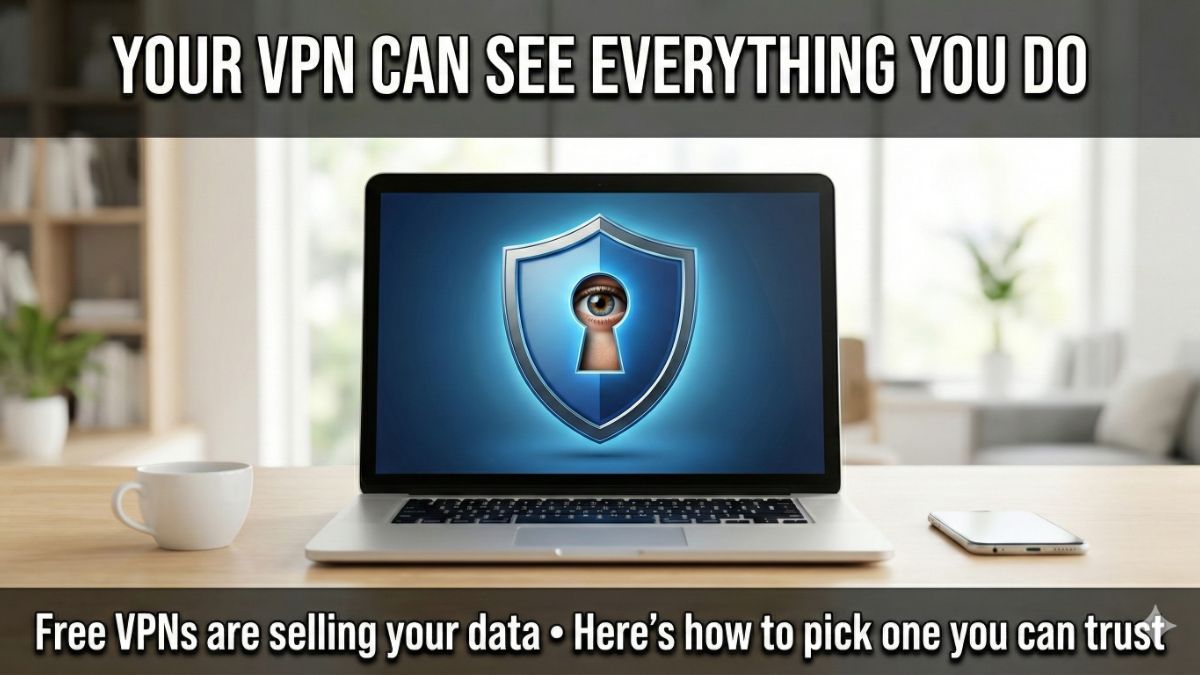
You’re paying a VPN to protect your privacy. But who’s protecting you from the VPN?
A VPN hides your traffic from your internet provider. But that means the VPN company can see it instead. Here’s how to tell if your VPN is actually trustworthy or just another company collecting your data.
⚡ TL;DR (THE SHORT VERSION)
- A VPN shifts your trust from your internet provider to the VPN company. That only helps if the VPN is actually trustworthy.
- No-log policy means nothing without independent audits to back it up.
- Free VPNs are the biggest red flag. If you’re not paying, your data is the product.
📖 Read time: 2.5 minutes
 Gemini

Protect your privacy. Get four months free when you sign up for a year at ExpressVPN.com/Kim.
February 14, 2026
I need your help: Add Komando.com as a preferred source on Google
Q: “I keep hearing you tell me that I need a VPN, but how do I know the VPN company isn’t spying on me? How do I know who to trust?” — David, Tucson, AZ
David, it’s the right question. A VPN encrypts your internet traffic, so your provider, hackers on public Wi-Fi and snoops can’t see what you’re doing. But here’s the catch. You’re handing that trust to someone else. The VPN company.
So the whole game comes down to one thing: Can you verify that trust? Here’s what to look for.
🚩 The no-log promise
Every VPN says they don’t keep logs of your activity. But saying it and proving it are two very different things. A real no-log policy means the company doesn’t store what sites you visit, what you download, your IP address or connection time stamps. None of it.
The only way to know if that’s true? Independent audits. Look for VPNs that hire outside firms (like KPMG, Cure53 or Deloitte) to crack open their systems and verify the claims.
No audit? That no-log promise is only marketing copy on a website.
🚩 RAM-only servers
Some VPNs run their entire network on RAM instead of hard drives.
That means every time a server reboots, everything is wiped. There’s nothing to seize, nothing to subpoena, nothing to hand over. It’s privacy enforced by hardware, not just a policy someone typed up.
🚩 Where they’re based matters
A VPN headquartered in a country with aggressive data retention laws can be forced to hand over records. Look for providers based in privacy-friendly jurisdictions, outside the reach of intelligence-sharing alliances like Five Eyes.
🚩 The free VPN trap
This is the worst. If you’re not paying for the VPN, you are the product.
Free VPNs have been caught injecting ads, selling browsing data and even bundling malware. A 2024 study found that over 70% of free VPN apps shared user data with third parties. Don’t do it.
I guess you could say when it comes to free VPNs, you get what you don’t pay for.
🚩 The transparency test
Trustworthy VPNs publish transparency reports showing how many data requests they’ve received from governments and what they handed over (ideally nothing). If a VPN won’t tell you that, walk.
My VPN pick? Keep reading.
ExpressVPN* checks every box I just described.
- They’ve completed 23 independent audits, more than any VPN in the industry. KPMG confirmed their no-log policy three separate times.
- Their servers run entirely on RAM, so every reboot wipes everything clean. When governments come knocking with data requests, ExpressVPN hands over nothing, because there’s literally nothing stored.
- They’re based in the British Virgin Islands, outside the reach of Five Eyes surveillance alliances.
✅ It’s the VPN I use and the one I trust with my own traffic. Get four extra months at ExpressVPN.com/Kim. Btw, I get no kickbacks or residuals if you buy. It’s the best.