



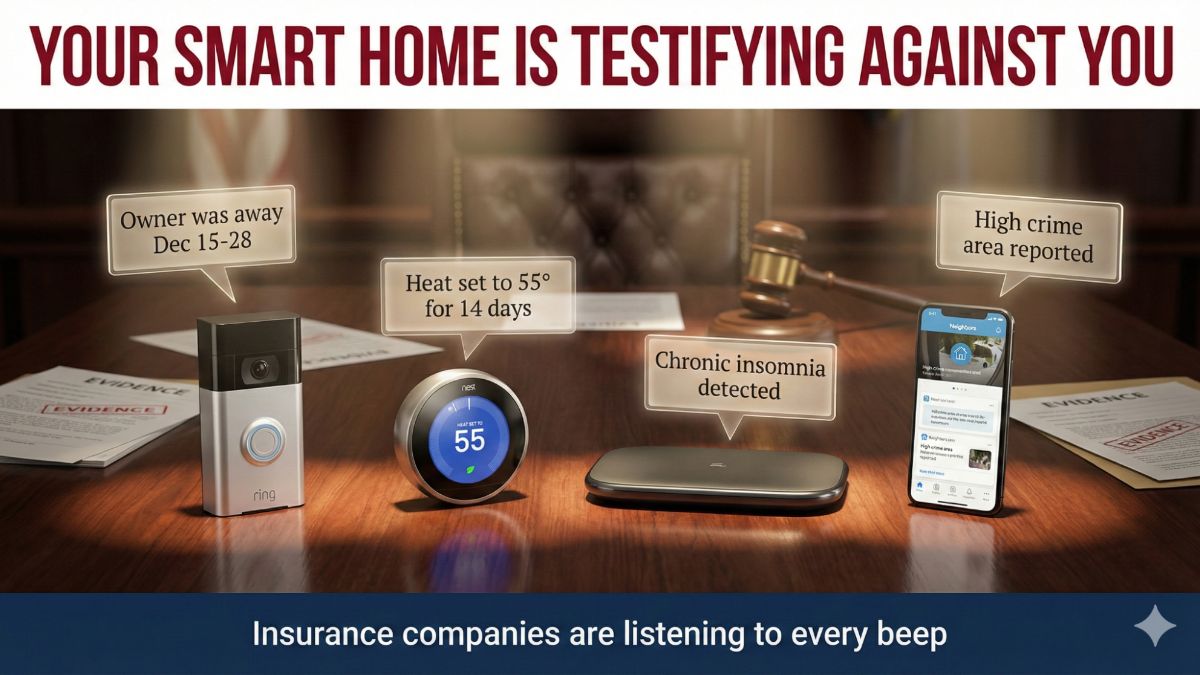
Your insurance agent offers you a “smart home discount.” Install a Nest thermostat or Ring doorbell, get $60 off your annual premium. No-brainer, right?
Here’s what the glossy pitch leaves out. That $5-a-month savings is a surveillance fee. And you’re paying for it with your privacy. The insurance industry calls it “lifestyle underwriting.”
I call it having an adjuster living in your guest room with a clipboard and a stopwatch.
🔍 The snitches in your house
- The thermostat traitor. Your Nest shows you kept the house at 55° for two weeks while vacationing in Maui. A pipe bursts. Your insurer pulls that data, argues you failed to maintain the property. Claim denied. Buy your own thermostat.
- The water sensor trap. Insurers like State Farm give free smart leak detectors. If that sensor pings a slow leak and you don’t fix it within 48 hours, they use the log to prove negligence. Claim denied.
- The smart plug problem. Had a fire on an overloaded circuit? Your insurer can subpoena wattage logs from apps like Wemo or TP-Link. If the log shows you pulled more power than the plug was rated for, that’s their user error excuse to walk away from the check.
- The smart bed snitch. Programs like John Hancock Vitality offer rewards for sharing sleep and heart rate data. Fun until your info shows chronic insomnia or a high resting heart rate. Suddenly your life insurance quote skyrockets because you’re a health risk.
- The neighborhood risk score. Even if you never share your Ring footage, the Neighbors app is public. Data brokers scrape those suspicious van posts to build crime scores for your entire street. Your porch pirate post could raise the rates of everyone on the block.
- The shadow credit score. Companies like LexisNexis and Verisk buy smart home data and sell risk scores to insurers. Those are basically a credit score for your house. Your insurer doesn’t have to ask you. They just buy it.
🛡️ How to muzzle the snitches
- Call your agent. Ask exactly what data is being shared for that smart home credit. If it’s anything beyond “device is active,” opt out. Your privacy is worth more than 5 bucks a month.
- Encrypt your Ring. Open Ring app > Menu > Control Center > Video Encryption > End-to-End Encryption > Enable. This locks everyone out. Including Amazon.
- Go local. Switch to cameras like Eufy (20% off) or Reolink (13% off) that store video on a hard drive in your home. No cloud, no subpoena bait.
- Pull your house’s credit report. Go to consumer.risk.lexisnexis.com and request your report. It shows every claim and incident tied to your name for seven years. You might be shocked.
Know someone who jumped on a smart home discount? Forward this. They have no idea what they agreed to.
We may earn a commission from purchases, but our recommendations are always objective.