That free Spotify tutorial stole your passwords. Here’s what to do.
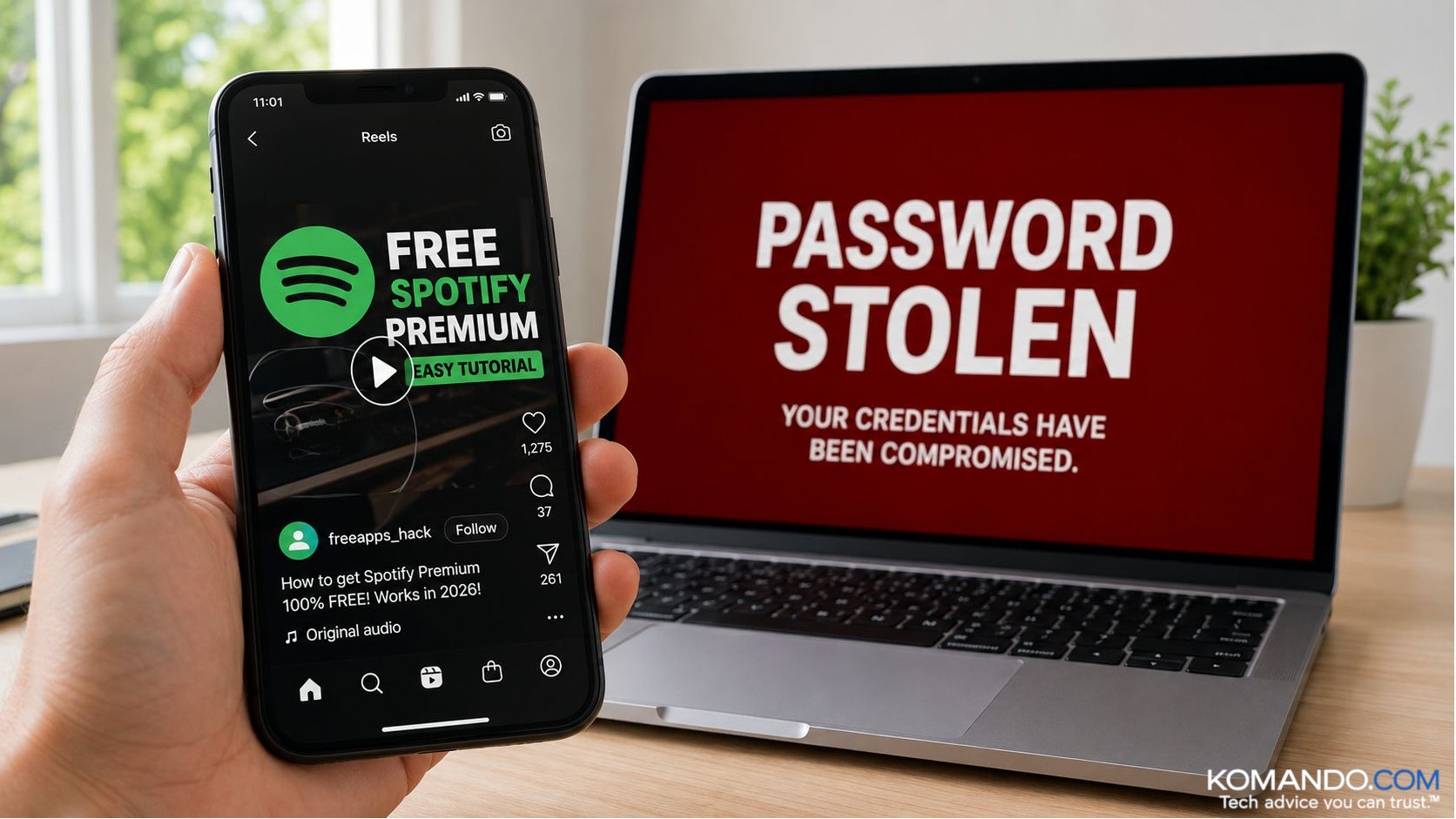
Criminals are running polished fake tutorial videos on social media promising free Spotify Premium, Microsoft Office and Windows activation. Following the steps installs a password-stealing malware called Vidar that quietly takes every saved login, bank credential and credit card number on your device. One video got 100,000 views. Here’s exactly what it grabs and what to do right now.
⚡ TL;DR
- Criminals are running polished fake tutorial videos on social media promising Spotify Premium, Microsoft Office and Windows activation, all for free. The tutorials are a trap.
- Following the steps installs an infostealer called Vidar that quietly lifts every saved password, bank login, credit card number and authentication token on your device.
- One of these videos racked up more than 100,000 views before anyone flagged it. Millions of people are seeing this content right now.
📖 Read time: 2 minutes
 ChatGPT/Kim Komando

Home Title Lock protects your home from title theft and deed fraud with 24/7 monitoring.
Get a Free Trial and a FREE Title History Report now at my.hometitlelock.com/kim
June 15, 2026
I need your help: Add Komando.com as a preferred source on Google
Your saved passwords. Your bank logins. The card numbers sitting in your browser. Even the codes that are supposed to stop a stranger from getting in when they have your password. Gone. All of it, copied and shipped to a criminal in seconds.
And you handed it over yourself. While watching a video.
You’re scrolling. A polished, professional clip pops up. Someone walks you through getting Spotify Premium for free. No credit card. No subscription. A few quick steps. You follow along. You type the command they show you on screen. That’s the whole trap.
🔍 What’s really going on
Researchers at ReversingLabs found two active campaigns using TikTok, Facebook and Instagram Reels to spread malware called Vidar. The accounts look legit. Names like “windows.tips” and “windows.insights,” real Windows-style branding, AI voice-overs so clean most people never suspect a thing. Criminals lean on the same algorithm that feeds you cooking videos and puppy clips to push this in front of millions. One tutorial passed 100,000 views before anyone flagged it.
The command they tell you to paste (PowerShell on Windows, Terminal on a Mac) quietly downloads and runs a script. Vidar installs in the background while you’re still watching. And Mac users, you’re not immune. The same “paste this to unlock it free” trick targets you. Different command, same break-in.
Vidar doesn’t grab one thing. It takes everything. Saved passwords, bank credentials, card numbers, crypto wallet details, the cookies that keep you logged in, even the tokens that let it walk right past two-factor protection. It sells as a service for $300 a lifetime license, and a stealth upgrade last October made it harder to catch. By the time you notice anything’s wrong, they’ve already got the keys to your entire digital life.
🔒 If that was you, move now
Followed a tutorial like this? Don’t panic. Don’t wait either.
- Grab a different, clean device and change your passwords there. Start with your bank, your email, anything financial. A password manager gives every account its own.
- Lock down two-factor with an authenticator app or a hardware key, not texts. Those make the stolen tokens far harder to use.
- Then run a malware scan with a trusted tool. Anything it flags, you’ve already started fixing.
The video looked like a shortcut. It was a one-way door.
🏡 Your home is next
When Vidar steals your bank login, that’s bad. When it steals your mortgage servicer login, it can be catastrophic.
Home title fraud starts exactly the way you’d expect after a breach like this. A criminal gets your personal information, forges your signature on a deed and transfers your home into their name. Then they take out loans against your equity or sell the property entirely. You find out after the damage is done.
It recently happened in Ohio. Terry Anderson and Angela Croley forged a quitclaim deed and had it notarized using a fake power of attorney to steal a house from a man with dementia in Jefferson Township. They filed it at the county recorder’s office on Oct. 8. By Oct. 14, his daughter had called the sheriff. By then, someone was already squatting in her father’s house and trying to sell his deed. Anderson and Croley pleaded guilty June 5.
The FBI says cybercriminals stole more than $275 million through real estate fraud from over 12,000 victims last year alone. And that number is going up.
You worked your whole life for that house. Here’s how Home Title Lock protects it:
- 24/7 monitoring. Their proprietary software scans the largest property record databases in the country around the clock, watching for any activity tied to your title. Any filing. Any change. Any attempt.
- Urgent alerts. The moment something hits your title, you get notified. Not days later. Not in a monthly report. Right away, while you can still do something about it.
- Restoration. If fraud does occur, their U.S.-based team of title restoration experts goes to work. They’ll spend up to $1 million in legal fees, filing costs and administrative support to fix the fraud and restore your title.
✅ Go to my.hometitlelock.com/kim for 25% off for up to two years and a free Title History Report. Don’t wait until it’s not your home anymore.
📩 Send this to someone who scrolls social media.