Your ring and watch are guessing. Calorie counts miss by up to 93%, and sleep stages are a bluff. Here’s how to wear one without letting it lie to you.
Stanford tested seven fitness trackers against lab gear. Heart rate passed. Calories missed by up to 93%, friend. Your ring is guessing at sleep stages and blood oxygen. Here’s how to stop it from fooling you.
🤯 WOW! Stanford tested seven popular fitness trackers against lab equipment. Heart rate was fine. Calorie counts missed by 27% on the best device and 93% on the worst. And that deep-sleep number? A guess built from your pulse and how much you wiggle.
The Short Version: Treat calories burned as fiction, watch trends instead of daily scores, wear watches snug and never let a wellness reading overrule a real symptom. Steps below.
📖 Read time: 1.5 minutes
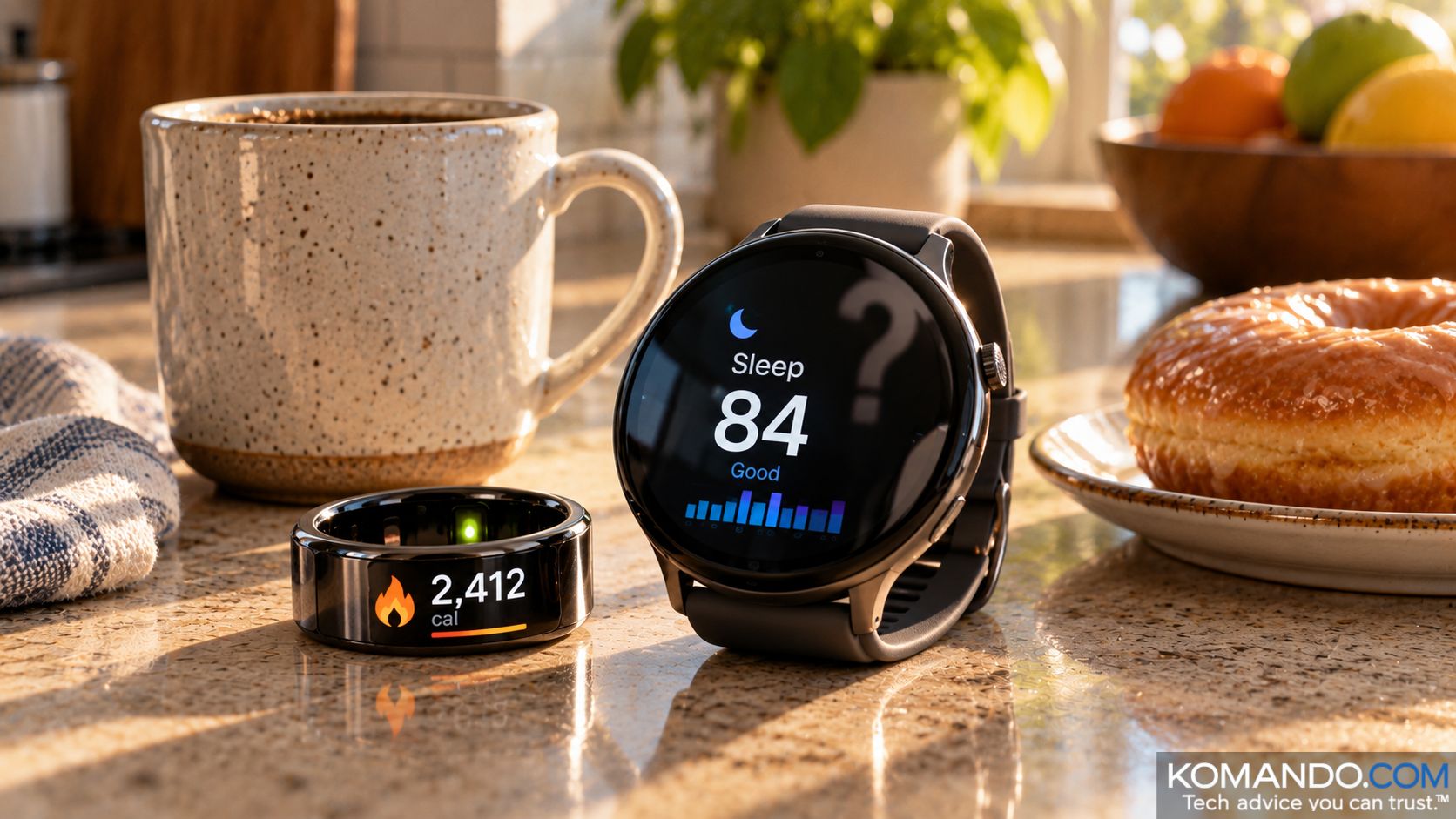 ChatGPT/Kim Komando
I need your help: Add Komando.com as a preferred source on Google
Every morning, a little screen hands you a verdict. You burned 2,412 calories and got 47 minutes of deep sleep. It feels like the truth, because it was done with computers.
Here’s what nobody selling a $349 ring says out loud: Those numbers are educated guesses. Some barely educated. I wear an Apple Watch and love it. But it’s a weather forecast, not a lab report.
🍩 Calories: Hole lot of nothing
Stanford tested seven wristbands, including the Apple Watch, Fitbit and Samsung, against lab gear. Heart rate? Six of seven within 5%. Calories? The best device missed by 27%. The worst by 93%.
The lead scientist’s verdict: “Basing the number of doughnuts you eat on how many calories your device says you burned is a really bad idea.”
Your watch never measures the oxygen your body uses. It guesses from your pulse, steps, age and weight. Eat those phantom calories back, and you own a diet saboteur with a nice band.
Same with sleep.
Rings and watches know you’re asleep and roughly how long. The light/deep/REM breakdown is a guess from pulse and movement, and sleep labs catch them misjudging it. If your ring says you slept terribly but you feel great, believe your body. (Obsess over the score, and you invent a new problem: orthosomnia, unhealthy pursuit of “perfect” sleep.)
Blood oxygen readings are “wellness” features, not medical data. The sensors are cousins of hospital pulse oximeters, and a major New England Journal of Medicine study found they were nearly three times more likely to miss dangerously low oxygen in Black patients. Readings ran falsely high on darker skin. The FDA warned about it. Short of breath? Don’t let a cheerful “98%” talk you out of calling your doctor.
Heart rate is solid at rest. But those little green lights get confused by a sweaty, bouncing wrist, tattoos, cold weather and a loose fit.
🔑 Wear it, don’t swear by it
- Calories burned are fiction. Never eat them back.
- Watch the trend, not the day. A resting heart rate creeping up for a week is real.
- Wear it snug, above the wrist bone. A loose band is a lying band.
- Training for real? Get a chest strap.
- A symptom beats a score. These gadgets have caught atrial fibrillation and saved lives. Your body gets the final vote.
Wear the ring. Trust your gut. And skip the extra doughnut because a gadget on your finger gave you permission. Smartwatch? More like a wrist-imate.
🎯 Send this to someone who eats back every calorie their watch says they burned. The number’s wrong, and so is the second doughnut.
📱 Text-worthy: Your fitness tracker is guessing. Stanford tested 7 of them: heart rate was accurate, calories burned were off by 27% to 93%. Never eat back the calories your watch says you burned, and don’t trust the sleep-stage breakdown either. Trends matter. Daily numbers don’t.