



You sent a smiley face. 🙂
You meant warm. Friendly. Happy, even. Your kid read it as passive-aggressive. Maybe threatening. Definitely suspicious.
Nobody told you the rules changed. But they did. The emoji you sent may not even look like what you think you sent.
📱 Not speaking the same language
This is the part nobody talks about. When you send an emoji, your phone doesn’t send a tiny image. It sends a code number. The receiving phone then draws its own version of that emoji, using its own design system. Apple and Samsung design theirs completely differently.
Send the eye-roll emoji 🙄 from your iPhone, and it looks like pure irritation. Crisp. Unmistakable. On a Samsung, the exact same emoji looks gleeful. Some describe it as drunk. Or suggestive. Your “I can’t believe you right now” arrived as “heh, interesting.”
The anguished face looks shocked on iPhone. On Samsung, it looks deeply sad with a little dejected sigh bubble. The smirk that reads as devious on Apple looks half-asleep on Samsung.
You’ve been sending the wrong message for years. So has everyone else.
🔑 The generational decoder
Then on top of the design problem, the meanings themselves have split by generation.
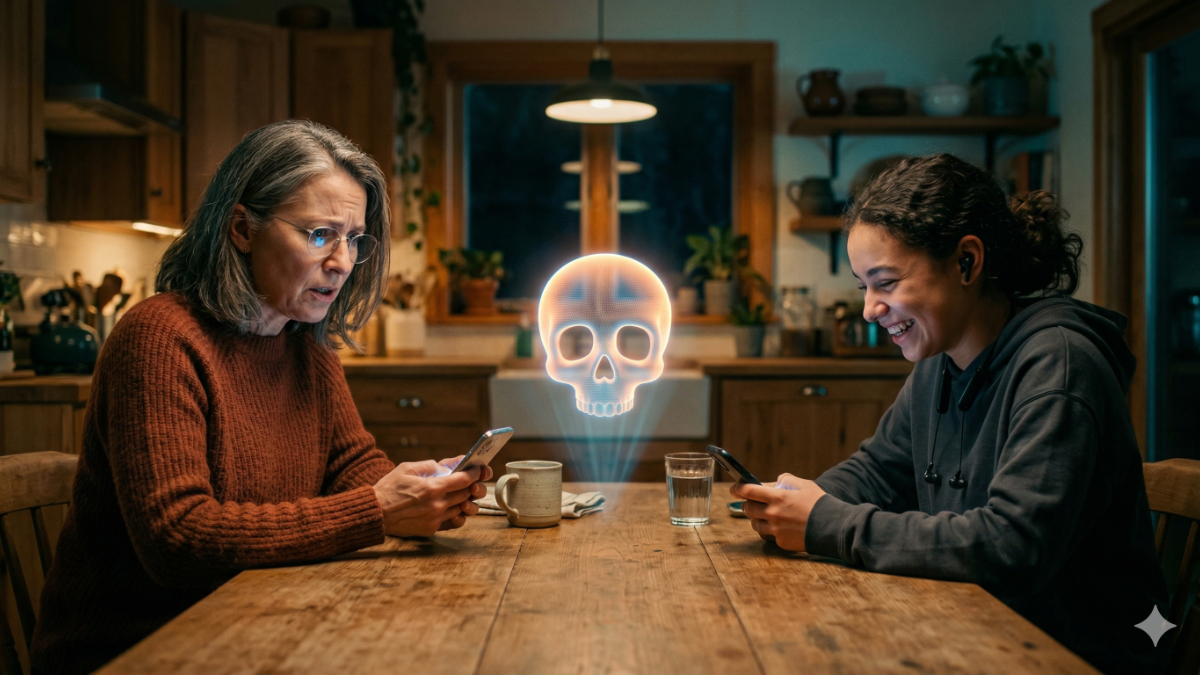
The skull 💀 means death to anyone over 40. To Gen Z, it means “I’m dead from laughing.” It’s a compliment. If a kid sends you one, you nailed it.
The plain smiley 🙂 is warm and friendly to anyone over 35. To Gen Z, it reads as passive-aggressive, cold or vaguely threatening. Use the cowboy instead. Don’t ask me why it works. 🤠
The thumbs-up 👍 means great job to most Americans over 40. Gen Z reads it as dismissive. And in a Canadian courtroom, a farmer sent one in response to a grain contract, and a judge ruled it legally binding. He owed $82,000. For a thumbs-up. In a text message.
The nail polish 💅 means sass and “I genuinely do not care.” Not beauty tips.
The crying laughing 😂 is how everyone over 40 expresses extreme laughter. Gen Z retired it. They use the skull.
A period at the end of a text. Not an emoji but worth mentioning. To anyone under 30, ending a casual text with a period means you’re angry, done or both. Punctuation has become passive aggression. We live here now.
😬 The stakes are real
One law professor has been tracking emoji in legal proceedings since 2004. His warning to every lawyer and judge in the country: “No matter how specialized your court, emoji evidence is coming for you.”
We are one misread eye roll away from a family feud or a lawsuit at any given moment.
Your move: Before you send that 🙂 to anyone under 30, use words. And check what your most-used emojis actually look like on Android before your next important conversation.
📩 Send this to someone who has ever spent 20 minutes trying to figure out if a one-word text with a period meant they were in trouble.