Facebook is the No. 1 place Americans lose money to scammers
New FTC data reveals scams starting on social media cost Americans $2.1 billion last year, and Facebook tops the list. Losses have exploded eightfold since 2020. Here are the exact settings that cut scammers off.
⚡ TL;DR
- Scams that started on social media cost Americans $2.1 billion in 2025, eight times more than in 2020.
- Facebook is the No. 1 platform for losses, beating all text and email scams.
- It’ll take you five minutes to change settings to cut off what scammers can see.
📖 Read time: 2 minutes




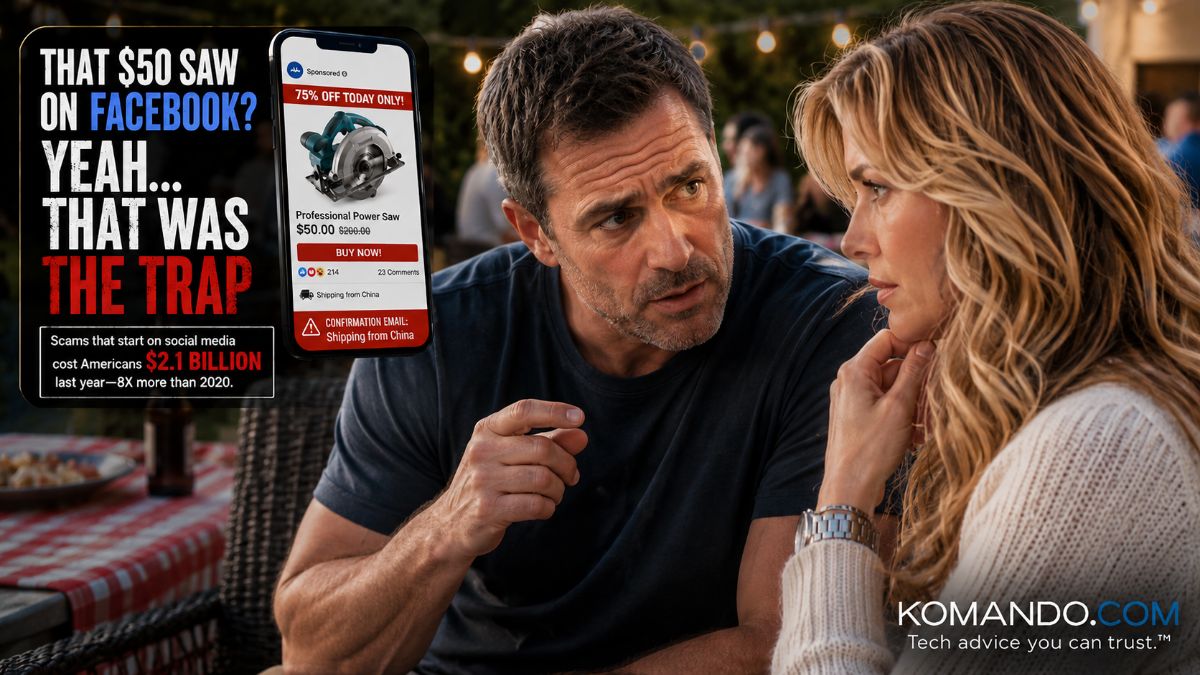 ChatGPT/Kim Komando
I need your help: Add Komando.com as a preferred source on Google
So I’m at a backyard BBQ this past weekend, and a guy sidles up next to me. Voice down. Eyes darting across the yard to make sure his wife’s out of earshot.
He saw an ad for a power saw on Facebook. Same one that’s $200 at Home Depot, marked down 75%. He grabbed it. Card went through. Confirmation email said, “Shipping from China.” That was two months ago. He’s messaged customer service. Same reply every time: “We’re working on it.”
And now? Strange charges are showing up on that card. He asks the question he’s clearly been sitting on for weeks. “Kim, did I get scammed?”
Buddy. Yes. You handed scammers a working credit card. The mystery charges? That’s your cash walking out the door, one swipe at a time.
New FTC numbers confirm it. Americans reported losing $2.1 billion to scams that started on social media last year. That’s eight times more than in 2020, and it beats every other way scammers reach you.
Nearly 1 in 3 people who lost money to any scam last year said it began with a post, an ad or a message in their feed.
💸 Facebook wears the crown
People lost more money to scams that started on Facebook than on any other platform. WhatsApp and Instagram came in a distant second and third.
Losses started on Facebook alone topped all text message scams. They topped all email scams, too. Every age group now loses more money through social media than any other way scammers make contact.
Why? Because scammers use the exact same ad tools legitimate businesses use. They pay Facebook to target you by age, interests and shopping habits. They read your public posts to learn what you’ll fall for. And they hijack your friends’ accounts, so the pitch comes from a face you trust.
The damage breaks down like this:
- Investment scams took $1.1 billion, more than half the total, usually starting with an ad promising to teach you how to invest.
- Shopping scams were the most common. Over 40% of victims ordered something from a social media ad that never showed up.
- And 60% of romance scam victims say it started on social media.
🔒 Lock it down
Give scammers less to work with. I checked these steps below, but yours may be different, depending on your device, OS, mobile vs. desktop, etc. Poke around, you’ll find it.
- On Facebook, go to Settings & privacy > Settings. Scroll to Audience and visibility. Tap or click Posts. Set Who can see your future posts? to Friends.
- Then, go back to Settings & privacy > Settings > Audience and visibility. Open How people find and contact you. This is important. Set Who can see your friends list? to Only me.
One more thing. The man who got burned on the saw scheme was hiding this from his wife out of embarrassment. Don’t. These scams are engineered by pros to fool smart people. And yes, I told him to dispute all the charges, cancel that credit card and stop being a dope.
That deal wasn’t a steal. It was a straight-up rip. (Saw that one coming.)
📩 Send this to someone who scrolls Facebook with their morning coffee.