



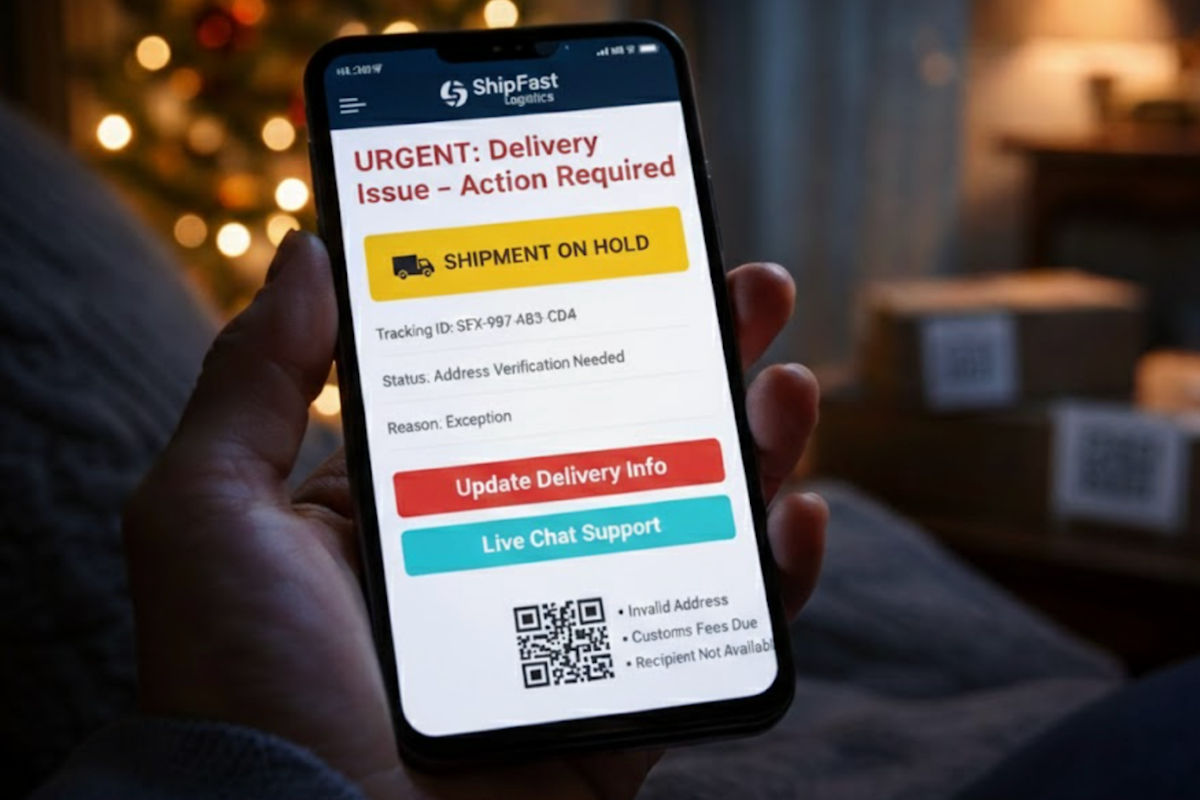
You waited until the last minute. I did, too. We’re both prime targets.
I’m seeing a sharp spike in AI-powered delivery scams hitting right before Christmas. These are not the sloppy phishing emails you’re used to deleting. They’re smart, personalized and designed to catch you when your guard is down.
⏱️ They’re timed and dangerous
These traps are no longer blasted out randomly. Scammers use AI to make their messages feel legitimate. They’re showing up:
- 30 to 90 minutes after a real delivery notification, when you’re already checking tracking.
- Late at night, when you’re tired and less skeptical.
- Between today, Dec. 22, and Christmas Eve, when panic overrides logic and everyone is racing the clock.
That’s why even people who know about scams are falling for these. The timing does half the convincing.
😳 They look authentic
The emails and texts use carrier logos, clean formatting and your actual name. That personal detail often comes from data breaches earlier this year. Scammers feed that information into AI to generate messages that look indistinguishable from the real thing.
Some even claim a “delivery exception” tied to a specific package. It feels urgent. It feels real. That’s the point.
🪤 The new traps
Instead of a link, many of these messages include a “Live Support” button or a QR code labeled something like “Scan to reschedule delivery.” Click it or scan it, and you’re dropped into a real-time chat with a polite, professional-sounding “agent.”
Perfect grammar. Calm tone. Fast replies. Sometimes even a fake escalation to another “department.” That agent is either an AI chatbot trained on real carrier scripts or a scammer using AI-generated responses.
After a few friendly messages, they’ll say there’s a small problem. An address issue. A redelivery fee. A final verification. Then they ask for payment using gift cards, crypto or a peer-to-peer app.
Stop right there.
If you’re worried, open the official carrier app or manually type the website into your browser yourself.