Your phone is a magic star map. Here’s how to use it tonight.
No telescope, no chart, no clue what you’re looking at? Doesn’t matter. The free app already in your pocket names every star you point it at, and one trick lets you see the stars beneath your feet. Plus, the farthest thing your eyes can ever reach.
⚡ TL;DR
- A free app turns your phone into a real-time star map. Point it up to name every star. Point it down to see the ones beneath your feet.
- Use it to find the Andromeda Galaxy, the farthest thing your naked eye will ever see, 2.5 million light-years away.
- Plus, the can’t-miss meteor shower coming Aug. 12-13 and how to catch up to 90 shooting stars an hour.
📖 Read time: 3 minutes
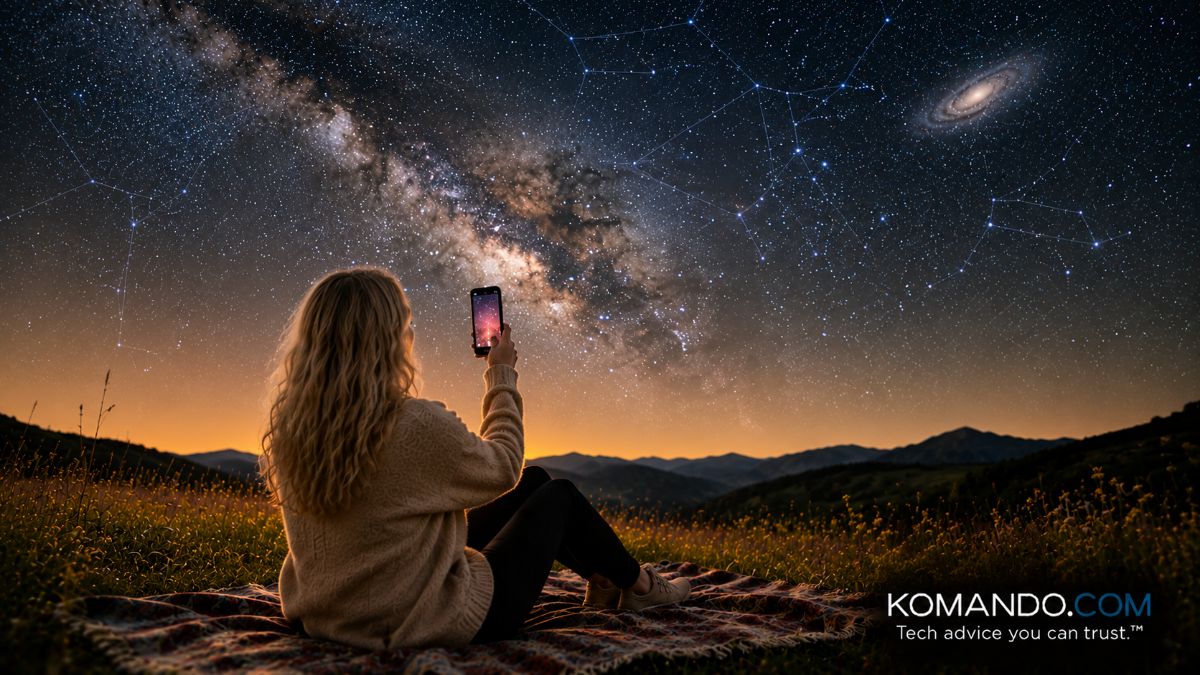 ChatGPT/Kim Komando
I need your help: Add Komando.com as a preferred source on Google
I’ll never forget it. Flat on my back on the top deck of a boat, drifting somewhere in the middle of the Galapagos Islands. No city lights. No noise. Under a sky so packed with stars it didn’t look real.
Then there was Bora Bora, the night I finally saw the Southern Cross with my own eyes, this thing I’d only ever heard about in a song. I actually got choked up. Every time I look up like that, I feel wonderfully small. And so thankful God created something that beautiful, then gave us front-row seats. Some views can’t be downloaded.
Here’s the best part. You don’t need a boat, a plane ticket or a telescope. Your phone does the work. Hold it up to the night sky, and it names every star, planet and constellation in real time.
The magic wand is already in your pocket. Tonight, go outside and look up. I promise the view is stellar.
📱 Turn your phone into a star map
Download a free app called SkyView Lite on Android or Apple. Open it, point your phone at the sky and watch it label everything you aim at: stars, planets, constellations, even the International Space Station sailing overhead. I wave every time. Don’t judge.
Want something deeper? Stellarium is free, too, and it can ping you before big sky events, so you never miss a good clear night.
Try this. Point your phone straight down at the ground. The app keeps right on going and shows you the stars over the far side of the planet, the ones beneath your feet this very second. You’re looking clean through the Earth.
🛑 One pro move before you head out: Turn on the app’s red night mode. Your eyes take a full 20 to 30 minutes to adjust to the dark, and a single glance at a bright white screen wipes that out instantly. Red light keeps your night vision intact. If you can, drive a few minutes past the city glow. It triples what you will see.
✨ Find the showstoppers
Use the app to track down the W shape of Cassiopeia. Beside it sits a faint, fuzzy smudge that looks like a smeared star. That smudge is the Andromeda Galaxy, and it’s the single farthest thing your naked eye will ever see. It sits 2.5 million light-years away. The light hitting your eye tonight left before our species even existed.
You’re not looking at a star. You’re staring 2.5 million years into the past.
Then set a reminder for Aug. 12 and 13. The Perseid meteor shower peaks, and this year, it appears during a new moon, so the sky goes pitch black and you could catch 90 shooting stars an hour. Aim your app at Perseus, lie back and wait for the show to start.
Your phone became a time machine. Use it.
🤣 Why didn’t the Dog Star laugh at the joke? It was too Sirius. (That’s the real name of the brightest star, by the way.)
📩 Send this to someone who has kids or grandkids and one clear night to expand their horizons.