On September 11, the phones didn’t break. They filled up. Here’s what still worked.
Twenty-five years ago, millions of Americans picked up the phone at the same moment, and most of them couldn’t get through. The network wasn’t destroyed. It was busy. That continues to happen in hurricanes and blackouts, and there are four things you can set up tonight that make you reachable when everyone else isn’t.
 ChatGPT/Kim Komando
I need your help: Add Komando.com as a preferred source on Google
Ian was an infant. I was asleep in a chair with him in my arms when Barry came in and whispered, “You have to get up and see what’s happening on the TV.” I put Ian in his bassinet, walked into the family room and said, “You got me up to see some scene in a movie?”
It wasn’t a movie. On the morning of September 11, 2001, we watched the horror unfold. Millions of Americans picked up the phone at the same moment. A business associate reached me and asked me to get word to his wife that he was OK.
The wireless network never went down. It filled up. Verizon carried close to double its normal traffic that day. Rescue workers at the towers couldn’t get calls through.
Then came the physical damage. Verizon’s building at 140 West Street sat across from the World Trade Center. Inside were roughly 300,000 phone lines, millions of data circuits and the city’s main 911 switch. When the towers fell, the walls were crushed, and the cable vaults flooded.
Twenty-five years later, the useful lesson isn’t limited to that day. A network does not have to be destroyed to be useless to you. It only has to be busy. Same story in hurricanes, wildfires and blackouts.
Here is what gets through.
📱 Text first, talk later
A voice call holds a channel open the whole time you talk. A text is a tiny packet that keeps retrying until it finds a gap. When a whole country picks up at once, texts land while calls do not.
Before an emergency happens, turn on Wi-Fi calling. If the towers are jammed but your internet is fine, your phone routes around the problem.
- iPhone: Settings > Cellular > Wi-Fi Calling.
- Android: Settings > Network & internet > Wi-Fi Calling (paths vary, so search Settings for “Wi-Fi calling”).
👥 One person, three states away
Local circuits jam first. So the immediate family doesn’t call each other. Everyone checks in with one relative outside the area, who keeps a list and passes it along. Pick that person tonight and tell them the job.
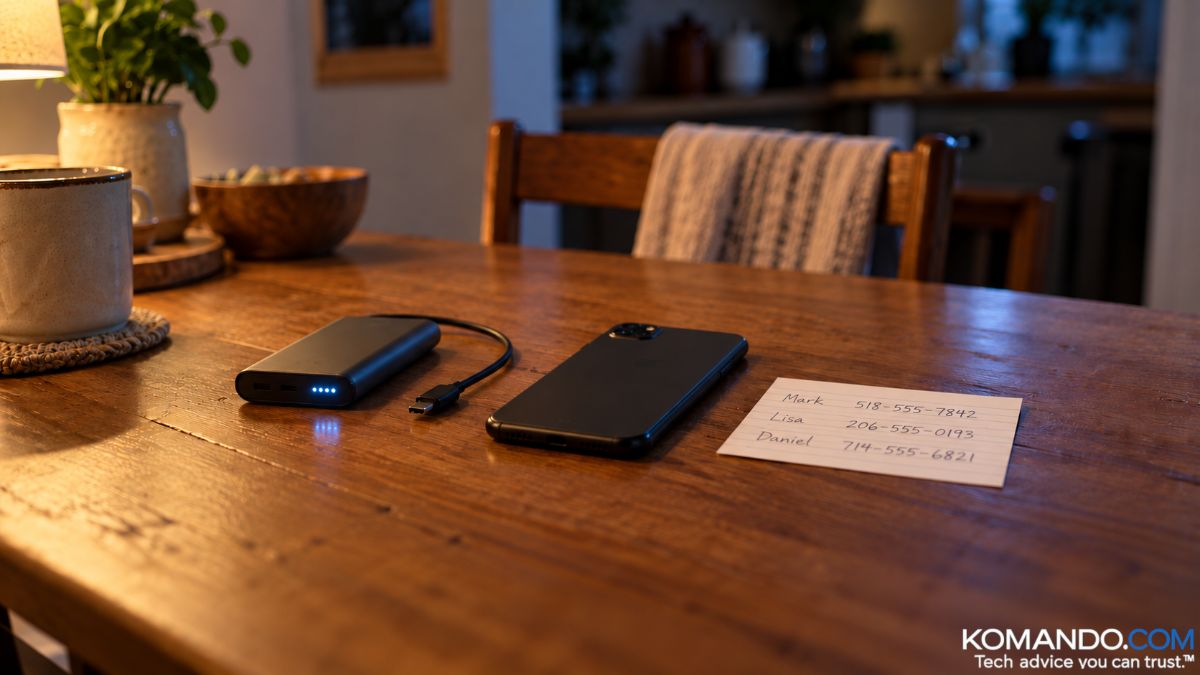
Then write three phone numbers on a card for your wallet. Nobody has memorized a number since 1998, and a dead phone takes the whole address book with it.
Last one: Charge the battery bank in your closet. The most common communication failure in a disaster is not the network. It is a phone at 4%.
Do it tonight, and you won’t think about it again until the day it matters.
📩 Send this to someone who has family in a hurricane state.