The Orionid meteor shower peaks tonight. Here’s when to look, where to look and how to catch a shooting star on your phone.
Bits of Halley’s Comet are hitting our sky at 148,000 mph, friend, and tonight is the peak. Free apps point you to the right spot, one site gives your town’s best hour and your phone’s night mode can catch a streak. Steps below.
🤯 WOW! Tonight, specks of Halley’s Comet smaller than a grain of sand slam into our sky at 148,000 mph. That’s fast enough to cross the entire country in about a minute. Some explode into fireballs. And the phone in your pocket can catch one.
The Short Version: The Orionids peak tonight. Here’s when and where to look, plus how to snap a shooting star on your phone. Steps below.
📖 Read time: 2 minutes




 ChatGPT/Kim Komando
I need your help: Add Komando.com as a preferred source on Google
Halley’s Comet last swung past Earth in 1986. It won’t be back until 2061. (I already have plans that year. Probably.)
But every October, Earth plows through the dusty trail it left behind. Those grains hit our atmosphere and burn up as shooting stars. That’s the Orionid meteor shower, and it peaks tonight, Wednesday, Oct. 21, into Thursday morning.
Under a dark sky, the peak brings about 20 meteors an hour. Orionids are fast and bright, and some explode into fireballs.
The catch? The moon is about 83% lit. The good news: It sets in the wee hours (around 3 a.m. in New York), so the best show is the stretch before dawn. Set an alarm. Bring coffee.
🔭 Find the show
- Get your town’s best hour. The free Meteor Tracker at orbitalradar.com shows your local peak time and when the moon goes down. Type in your town.
- Download a free sky app like Stellarium or SkyView Lite. Hold your phone up, and it points you to Orion and its bright red star, Betelgeuse.
- Then look away from Orion. Meteors seem to fly out of it, but the ones farther away leave longer, prettier streaks.
- Get dark. Find a spot away from streetlights, lie back on a blanket and give your eyes 20 minutes to adjust. Turn your screen brightness all the way down. Every glance at a bright screen resets the clock.
📸 Catch one on your phone
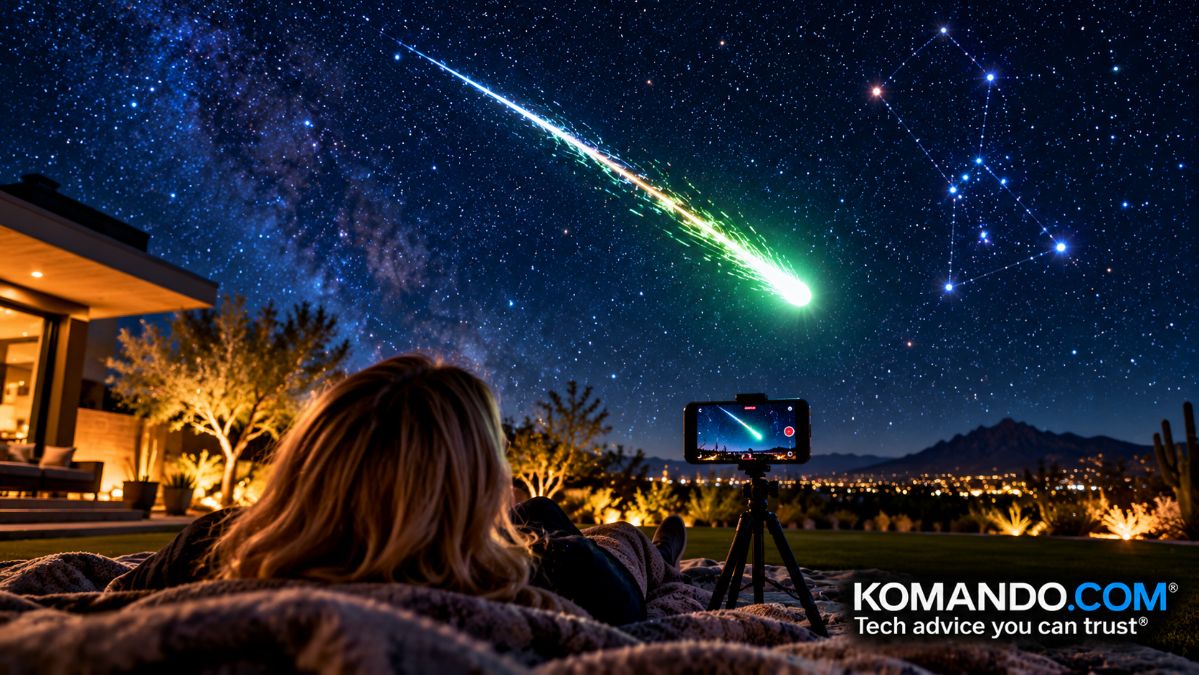
A meteor lasts about a second, so your phone has to be pointed and shooting before it shows up. Prop it on a cheap tripod or a stack of books, aimed at a wide patch of sky.
- iPhone: Night mode turns on by itself in the dark. Once the phone is on a tripod, tap the moon icon and slide it to the max, up to 30 seconds.
- Pixel: Switch to Night Sight and keep it still. When the shutter button turns into stars, Astrophotography mode is on.
- Samsung Galaxy: Open Pro mode and set the shutter to about 20 seconds.
Use a three-second self-timer, so your tap doesn’t shake the shot. Then shoot again. And again. Most frames will be empty. That’s normal. Pros shoot all night to snag a few streaks.
Cloudy? Thursday night is nearly as good. Orionids keep falling, just fewer of them, through Nov. 7.
How do you get clean in outer space? You take a meteor shower.
🗣️ Text/post this stat: Tonight, bits of Halley’s Comet hit Earth’s sky at 148,000 mph, and the Orionid meteor shower peaks before dawn. Look up. GetKim.com
📩 Send this to someone who is always up at 3 a.m. anyway.