The best meteor shower of 2026 peaks tonight, and this year, the sky cooperates. Here’s how to watch and how to catch one with your phone.
Tonight, Earth plows through a comet’s dust trail: the Perseid meteor shower, up to 100 shooting stars an hour, visible from every state. This year’s peak lands on a new moon, the darkest viewing in years. When to look, where to look and the phone camera settings that can catch a falling star.
🤯 WOW! Tonight, Earth slams into a comet’s dust trail, and grains of sand hit our sky at 133,200 mph, burning at 3,000 degrees, 60 miles over your lawn chair. Up to 100 shooting stars an hour, visible from every state.
The Short Version: Get away from porch lights after 11 tonight, give your eyes 20 minutes, look up (no telescope, no ticket) and prop your phone for a long-exposure shot. Steps below.
📖 Read time: 2 minutes
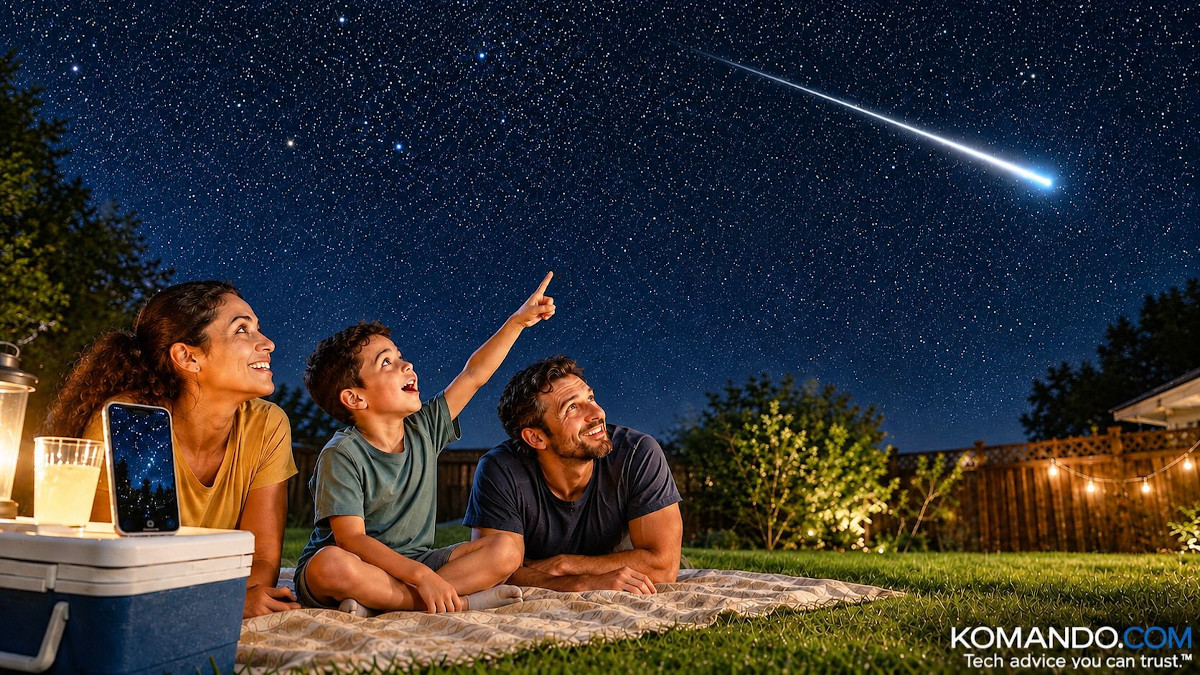 ChatGPT/Kim Komando
I need your help: Add Komando.com as a preferred source on Google
When you’re married to a science nerd, date night is two lawn chairs at 11 p.m. and a man whispering, “Wait for it” at the sky. Tonight, there’s a show playing over all 50 states. No tickets required, no login, no password sharing crackdown.
☄️ What you’re actually seeing
Every August, Earth plows through the dust trail of comet Swift-Tuttle, a 16-mile-wide mountain of ice that swings by every 133 years. The “shooting stars” hit our atmosphere at 133,200 mph and burn up 60 miles overhead at 3,000 degrees.
Tonight into tomorrow’s predawn is the peak: up to 100 meteors an hour under dark skies.
The new moon means zero moonlight washing out the faint projectiles. Sky watchers wait years for this lineup. That’s why I was excited to tell you.
🌠 How to watch
- Go outside after 11 p.m., the later the better. Predawn is prime time.
- Get away from lights. Even your porch light hurts. A dark backyard works, a park or country road works better.
- Give your eyes 20 minutes to adjust, and no phone scrolling. One glance at a bright screen resets the clock.
- Lie back and take in as much sky as you can. No telescope, no binoculars. They narrow your view, and meteors streak everywhere.
📸 Catch one with your phone
Prop the phone against something steady (a tripod, a coffee mug, the cooler) aiming at open sky. Set a three-second timer, so your tap doesn’t shake the shot. Turn on airplane mode, so a call doesn’t ruin the exposure. And take a bunch of pictures. Catch even one streak, and you’ve got tomorrow’s group chat trophy.
- iPhone: Night mode kicks in automatically. When the phone senses it’s braced, it offers its longest exposure, up to 30 seconds. Tap the moon icon up top and drag the slider to Max.
- Pixel: Open the Camera app and swipe to Night Sight. Prop the phone and hold still. When it stops detecting movement, you’ll see Astrophotography on and a little stars icon. Tap the shutter, then don’t touch it. It’ll take a several-minute exposure and even stitch a mini time-lapse of the sky.
- Samsung Galaxy: Grab the free Expert RAW app from the Galaxy Store (recent Galaxy S and Z models). Open it, tap the constellation (Astrophoto) icon in the top toolbar, choose your exposure time of four, seven or 10 minutes and tap the shutter. Longer means more streaks.
- Other Androids: Look for Night mode in your camera app, or open Pro mode and stretch the shutter speed as long as it’ll go. Poke around and you’ll find it.
Clouds in the forecast? The shower runs strong a night or two past the peak. Tonight’s just the headliner.
Why does a shooting star taste better than a comet? It’s a little meteor.
🎯 Send this to someone who has a lawn chair, a kid or both.
📱 Text-worthy: TONIGHT: Perseid meteor shower peaks, up to 100 shooting stars/hour, visible from every state, and there’s no moon, so it’s the darkest peak in years. Go out after 11, no telescope needed. Prop your phone on night mode, and you might catch a falling star.